


Originally published on LinkedIn.
Everyone is excited about AI coworkers. Fewer people are asking who's responsible when they act.
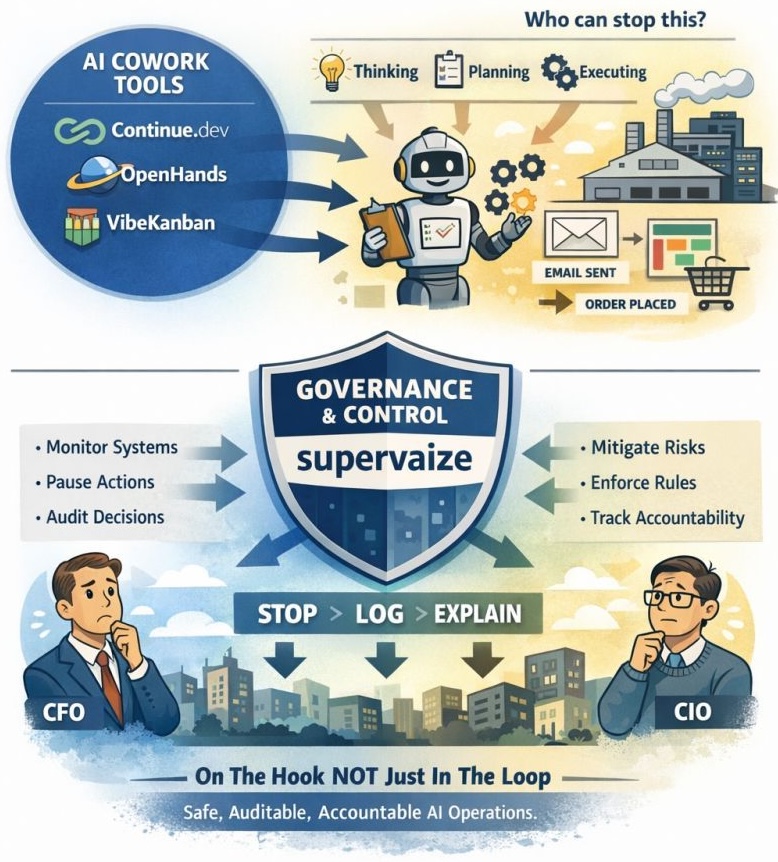
Tools like OpenHands, Continue.dev, VibeKanban, and Claude's cowork direction are pushing AI from "assistive" to semi-autonomous. These tools are great at thinking, planning, acting.
But they mostly stop before the hard part: operating those actions safely in the real world.
Once an AI task touches production data, triggers workflows, sends emails, orders inventory, or updates systems — the question is no longer "did the AI help?" It's "who is responsible, who can stop it, audit it, explain it?"
This is where a missing layer appears.
AI coworkers → cognitive and execution surfaces
A control plane like Supervaize → operations, governance, supervision, accountability
Think of it this way:
- These tools help teams decide and act faster
- Supervaize exists so teams can remain in control when things go sideways
That means:
- AI coworkers can be paused, throttled, or overridden
- Every action has a decision trail
- Business leaders have a real operational dashboard — not a dev console
- Governance is built into the workflow, not bolted on after the fact
The future isn't AI coworkers OR human oversight. It's AI coworkers WITH operational control — and that's where Supervaize sits.
Stop → Log → Explain. On the hook. Not just in the loop.