


Originally published on LinkedIn.
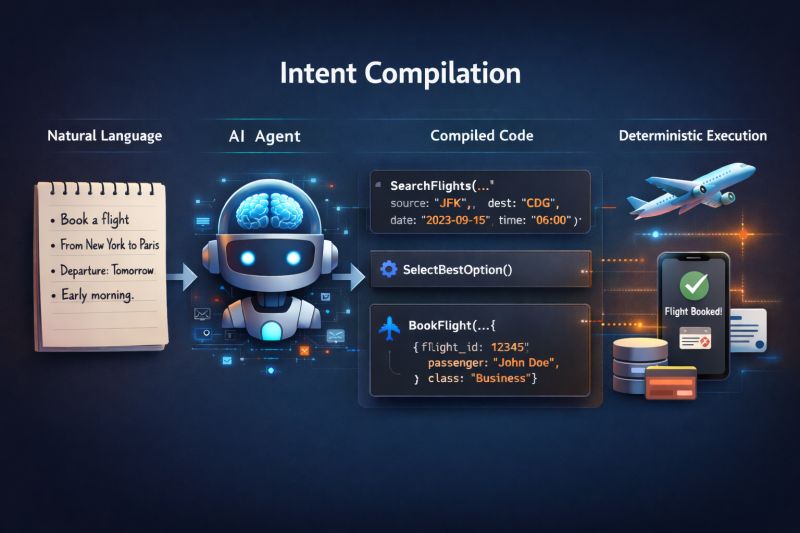
We are now ready for a new programming model: "Intent Compilation".
Users write specifications in natural language — what they want, not how to do it — and the agent compiles those specs into executable code. The spec is the source. The code is the artifact. The agent is the compiler.
Why does this matter now? Because we've learned enough about agentic systems to know that full non-determinism is a dead end for production. Letting the model reason its way through every single step is expensive (tokens add up fast), slow (round-trips kill latency), and unreliable (more reasoning steps = more surface area for hallucination). Pure non-deterministic execution does not scale.
But pure deterministic code cannot handle the ambiguity and variability that agents face in the real world. Inputs are unpredictable. Context matters. Rigid pipelines break.
The winning architecture is hybrid: deterministic scaffolding with non-deterministic intelligence injected where it actually adds value. Know when to think. Know when to execute.
Intent Compilation is how we get there. You declare intent. The system compiles it into hybrid execution plans — deterministic where possible, agentic where necessary. Fast, auditable, and controllable.
This is the direction we've been building toward with the Supervaizer open-source runtime. And it's where the entire agentic ecosystem is heading.
The age of "let the model figure it out" is ending.
The age of compiled intent is beginning.