


Originally published on LinkedIn.
I've been running OpenClaw in production for a few weeks now. It's powerful. It's chaotic. And it forces uncomfortable questions.
Installing it safely is non-negotiable. Dedicated machine. Isolated credentials. Segmented network. Some teams are giving OpenClaw the keys to a fat purse — unlimited token spend, full system access, YOLO mode enabled. They may be right. I am not there. Yet.
Initially, I was working for it more than it was working for me. So I created a middle management layer. I don't give OpenClaw instructions directly anymore.
My Codex has full credentials to my OpenClaw machines. When I need something done, I ask Codex. It figures out what to delegate, how to phrase it, what to check. Saves tokens. Saves back-and-forth. And more importantly — it forces me to question what OpenClaw is actually useful for.
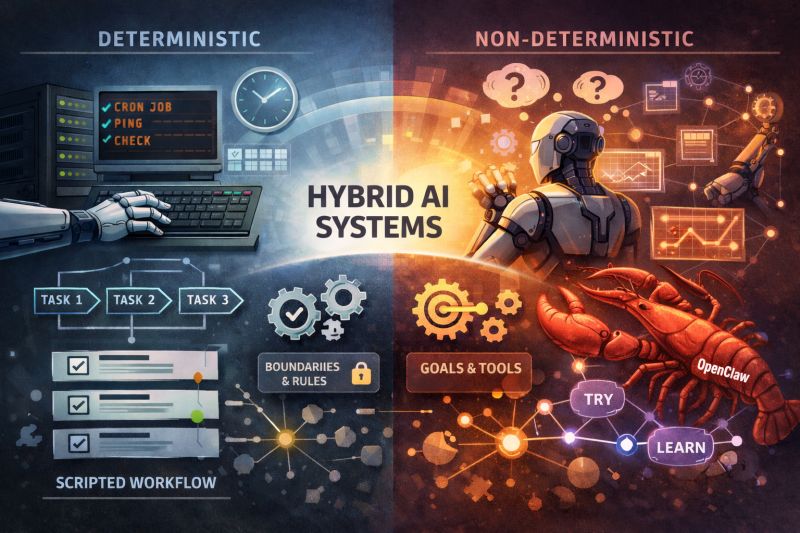
There is something fundamentally wrong with letting a non-deterministic system improvise solutions to problems that should have deterministic answers. Most tasks in production environments have correct procedures. When OpenClaw "figures out" how to deploy, configure, or modify something — it's improvising. And improvisation in ops is a risk vector, not a feature.
This is where hybrid AI architecture becomes essential — and it's exactly what we're building at Runwaize. The thesis:
Know when to think. Know when to execute.
Deterministic scaffolding handles what should be predictable: workflows, policies, compliance checks, sequencing. Non-deterministic intelligence kicks in where it actually adds value: interpretation, edge case handling, natural language understanding, creative problem solving.
OpenClaw is a fascinating tool. But it also proves that the hardest problem in agentic AI isn't capability — it's control.