


Originally published on LinkedIn.
The divide is becoming impossible to ignore.
AI personal assistants and enterprise agentic platforms are not the same thing — they won't converge because they solve fundamentally different problems.
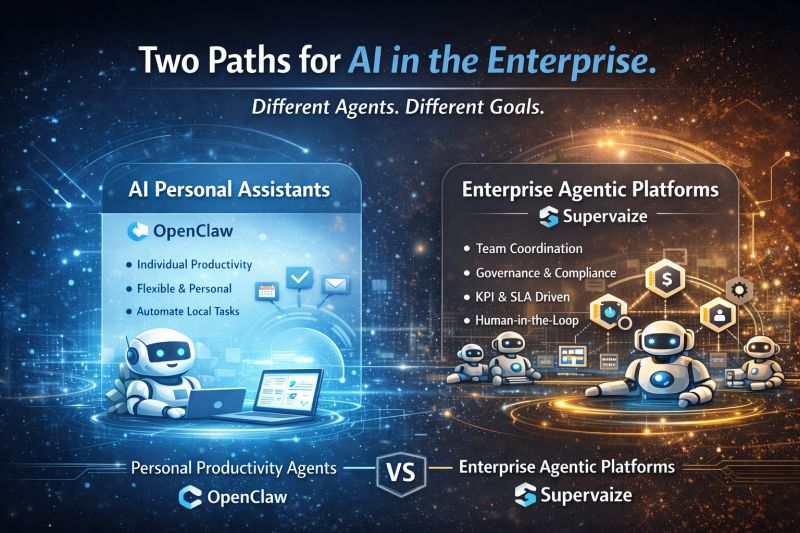
Tools like OpenClaw or Claude Co-work are AI operating systems for individuals. They sit close to the user, understand personal context, automate local workflows (inboxes, calendars, docs, scripts, browsers). Powerful, flexible, personal.
Enterprises face a different reality entirely.
They don't need AI that helps one person work faster. They need systems that act across teams and departments, operate under strict governance and compliance, optimize for shared outcomes (not individual convenience), and can be supervised, audited, throttled, stopped.
This is where enterprise agentic platforms live — and where Supervaize fits.
Supervaize isn't a personal assistant.
It's a control plane for autonomous work: multiple agents, shared objectives, explicit guardrails, human-in-the-loop by design.
Personal AI assistants win on flexibility and speed. Enterprise agentic platforms like Supervaize care about control, accountability, and scale. Stretching one into the other may ends badly.
The real future isn't one agent to rule them all — it's a clear separation of roles:
- personal agents for individual productivity,
- supervised agentic systems for business execution.
Different users. Different risks. Different architectures.
That distinction is now becoming impossible to ignore.